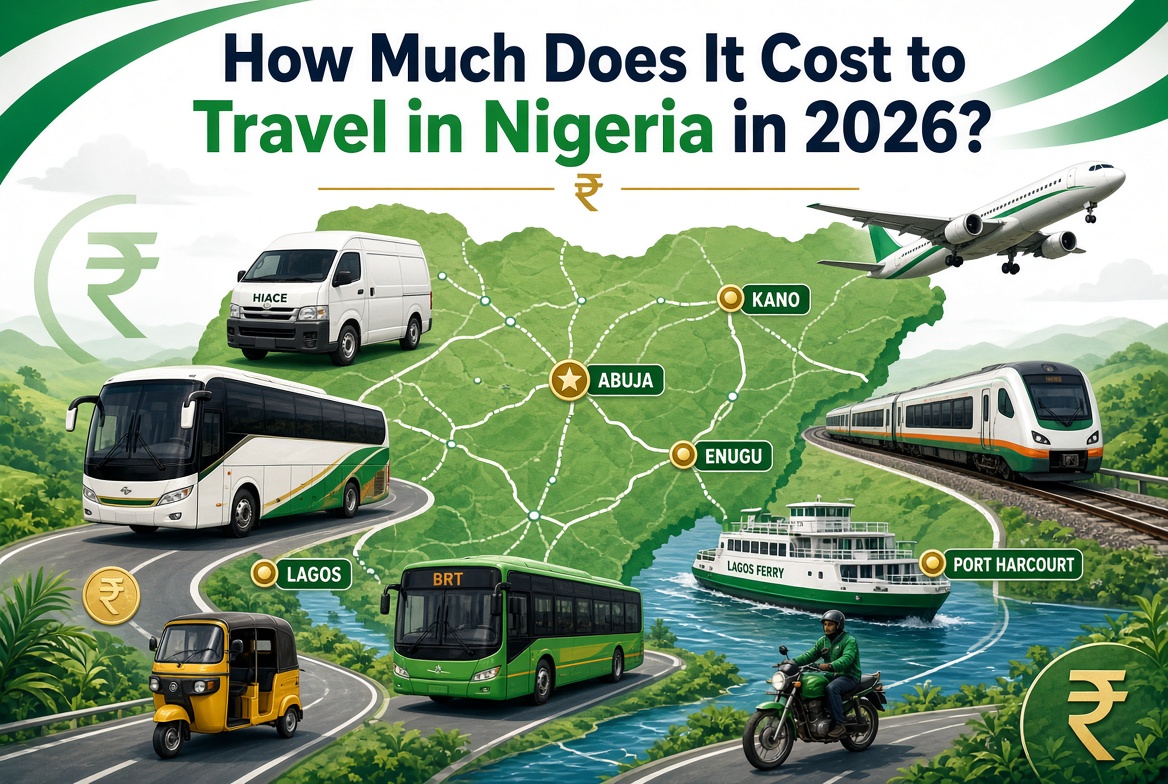
How much does it cost to travel in Nigeria right now?
That’s the question behind every search for transport fare in this country. And it’s a question that deserves a proper answer.
Nigeria is a big country. Over 200 million people. 36 states plus the FCT. Thousands of routes connect hundreds of cities and towns. Getting from point A to point B is something every Nigerian does regularly. But knowing how much it should cost? That’s where things get confusing.
Transport fares in Nigeria change constantly. Fuel prices go up. Inflation bites harder. Festive seasons push prices through the roof. New toll gates appear. Airlines adjust their rates. Train services expand. Ferry routes open.
Keeping track of all of it is exhausting.
That’s exactly why we built this guide.
This is the most complete transport fare resource for Nigeria in 2026. We cover every major mode of transportation. Road. Air. Rail. Water. We break down fares by route, by vehicle type, and by operator. We explain why prices change and how to find the cheapest options.
Whether you’re a student on a tight budget, a business traveller watching expenses, a family planning a holiday trip, or just someone trying to figure out how much it costs to get home, this guide has you covered.
Let’s go through it all.
Important Note: All fares listed in this guide are estimates based on the most current 2026 data. Nigerian transport fares fluctuate frequently due to fuel costs, inflation, demand, and government policy. Always confirm prices directly with operators before traveling.
Before we get into specific prices, let’s make sure we understand the basics.
What Is Transport Fare?
Transport fare is simply the price you pay to travel from one place to another using any form of public or commercial transportation. It’s the cost of your ticket — whether that ticket is for a bus, a plane, a train, or a boat.
In Nigeria, transport fare covers:
- Road transport — Buses, minivans, motorcycles (okada), tricycles (keke), taxis, and ride-hailing services
- Air transport — Domestic and international flights
- Rail transport — Train services operated by the Nigerian Railway Corporation
- Water transport — Ferries, speedboats, and water buses
Why Transport Fares Matter
Transport fares affect every Nigerian. Here’s why they matter so much:
They eat into household budgets. For millions of Nigerians, transportation is the second or third largest monthly expense after food and rent.
They affect business costs. When transport fares rise, the cost of goods rises too. That bag of rice costs more partly because it costs more to move it from the farm to the market.
They determine mobility. When fares are too high, people can’t afford to travel. Students miss school. Workers miss jobs. Families stay apart.
They reflect the economy. Transport fares are a real-time indicator of Nigeria’s economic health. When fuel prices spike, fares spike. When inflation rises, fares follow.
How to Book Train Tickets
Booking train tickets in Nigeria is now easier than ever:
Option 1: Online via the NRC app or website
- Download the Nigerian Railway Corporation (NRC) booking app
- Create an account
- Select your route, date, and class
- Pay online
- Receive your e-ticket
- Show it at the station on travel day
Option 2: At the train station
- Visit the station
- Go to the ticket counter
- Choose your route, date, and class
- Pay (cash, card, or transfer)
- Receive your physical ticket
Option 3: Third-party platforms